Quick Summary
- ✦ Manual certificate verification increases the risk of fake credentials, forged seals, and human operational errors.
- ✦ Online certificate verification systems provide instant, tamper-proof authenticity checks through dynamic QR codes and secure links.
- ✦ Institutes and HR teams save hundreds of productive administrative hours by automating bulk issuance and third-party checks.
- ✦ Centralized digital certificate databases improve audit readiness, long-term compliance, and archival safety.
- ✦ Verified credentials boost candidate confidence on professional networks like LinkedIn and elevate institutional reputation.
- ✦ Deploying a dedicated platform like the gaverify certificate verification system requires zero IT overhead or technical complexity.
Understanding the Real Difference Between Manual and Online Verification
Many institutes, training academies, universities, and corporate HR teams continue to rely on manual certificate verification procedures. These workflows typically involve inspecting physical printouts, cross-referencing student names across disconnected spreadsheets, or fielding verification emails and phone calls one by one from prospective employers.
While this manual approach functioned adequately when issuing small certificate batches of 20 to 30 students a year, it becomes unsustainable and dangerous as organizations expand their training cohorts, internship pipelines, and corporate certifications.
An online certificate verification system fundamentally changes this operational bottleneck. Certificates are issued digitally with unique, cryptographic verification identifiers. Anyone—whether a recruiter, regulatory body, or university admissions officer—can confirm authenticity within seconds by scanning a QR code with any mobile camera or clicking a dedicated verification link.
The shift is not simply a cosmetic technological upgrade; it is an organizational transformation that removes fraud risk and administrative friction.
How Manual Certificate Verification Actually Works in Offices
In most traditional organizations, certificate handling follows a repetitive, highly vulnerable cycle:
- A static certificate is designed in Canva, Photoshop, or Word and saved as a static PDF or printed on card stock.
- The student or employee stores the physical document or PDF locally on their phone or laptop.
- A recruiter, hiring agency, or background verification firm contacts the issuing institute via email to validate credentials.
- An administrative staff member manually combs through legacy spreadsheet rows or paper binders.
- A confirmation email is drafted and sent back days—or weeks—later.
1. High Risk of Fake Certificates
Standard printed documents and editable PDF files can be modified in minutes using basic browser tools or graphic design apps. Student names, course descriptions, grades, issue dates, and director signatures can easily be altered. Without a public, cryptographic validation mechanism, authenticity depends entirely on human checking. Because background verification is time-consuming, hiring teams frequently skip it entirely—exposing organizations to hiring fraud.
2. Disproportionate Time Consumption for Admin Staff
Training institutes issuing hundreds of credentials per month face a continuous deluge of verification emails. HR departments managing internal compliance certifications spend hours every week confirming course completions. This manual validation siphons valuable staff hours away from student education and strategic operations.
3. Absence of a Centralized Lifetime Record
Certificates saved across random folders or lost inside email threads are notoriously difficult to track over 3, 5, or 10-year timelines. When institutional audits, university accreditations, or legal compliance checks occur, retrieving historical student records becomes an emergency.
How an Online Certificate Verification System Improves the Workflow
A dedicated verification platform introduces structured control and total visibility into the credential lifecycle:
Instant QR Code Verification
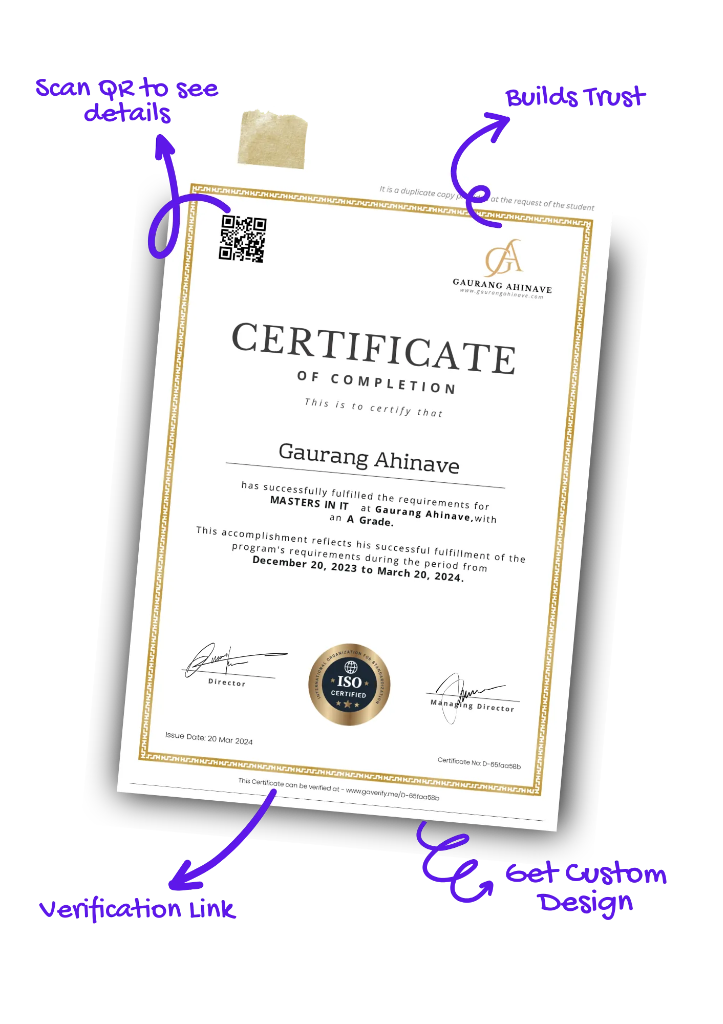
Each digital certificate is generated with an embedded, dynamic QR code pointing to a secure verification portal. When scanned, it opens an official landing page displaying authoritative record details:
- Recipient full name and unique certificate identification number.
- Certified program, syllabus version, and grade/honors awarded.
- Official issue date, issuing institute branding, and valid accreditation badges.
- Live authenticity status confirmation directly on your branded subdomain.
You can test this flow yourself on our live verification demo: Check live sample verification page (Cert #D-e9f496db) ➔
Tamper-Proof Cloud Hosting
When credential records are hosted on secure, distributed cloud infrastructure, unauthorized local edits become useless. Even if a bad actor alters the text on a downloaded PDF copy, scanning the QR code or visiting the URL immediately exposes the original, unedited records directly from the database.
Automated Bulk Issuance via CSV
Rather than designing or filling out certificates one by one, administrators can upload a single CSV file with hundreds of student records. The system automatically populates custom branded certificate templates, generates unique QR codes, provisions permanent verification pages, and sends out download links to students in seconds.
Workflow Comparison: Manual vs Online Matrix
Here is how manual handling compares to an automated verification platform across critical operational parameters:
| Operational Factor | Manual Process | Online QR System (Gaverify) |
|---|---|---|
| Verification Speed | 2 to 7 business days via email | Instant (< 2 seconds) via QR scan |
| Fraud Prevention | Low; PDFs and stamps are easily forged | Tamper-proof; verified via cloud record |
| Admin Workload | Hundreds of hours spent searching records | Zero human intervention required |
| Issuance Scalability | Manual copy-paste limited to small batches | Bulk CSV upload for 1,000+ certificates |
| Long-term Archival | Fragmented across PCs and spreadsheets | Lifetime searchable cloud database |
| Brand Trust | Generic paper with no digital proof | Branded verification page & LinkedIn badges |
Real Use Case: Training Institutes Scaling Monthly Programs
Consider a professional computer training academy or coding boot camp graduating 250 students across different engineering disciplines each month.
Under the manual method, staff must spend days formatting individual documents, manually tracking student IDs in spreadsheets, fielding continuous inquiries from HR agencies, and re-issuing misplaced copies.
With the gaverify certificate verification system, the administrative coordinator uploads one CSV spreadsheet on graduation day. Within two minutes, all 250 certificates are generated with unique QR codes, distributed automatically via email, and made permanently verifiable. The administrative team reclaims dozens of productive hours every cohort.
Real Use Case: Corporate HR Managing Upskilling & Compliance
Enterprises conduct quarterly cybersecurity certifications, safety orientations, and compliance workshops. When external auditors or executive leadership demand evidence of employee completion, manual documentation frequently fails:
- Spreadsheets suffer from version mismatches across multiple team folders.
- Paper sign-in sheets get misplaced during office relocations.
- Verifying whether an internal candidate is certified for a promotion requires manual email back-and-forth.
A digital verification repository acts as an immutable system of record. HR teams can search employee records in seconds, export audit-ready reports, and guarantee 100% compliance transparency.
Why Online Verification Builds Institutional Credibility
Institutes and training academies that issue verifiable credentials immediately project transparency, rigor, and professionalism. It proves to students and employers that the institution takes educational standards seriously.
Hiring recruiters favor candidates whose certifications can be independently validated with one click. When your students display their certificates on LinkedIn, each share functions as a high-authority referral directly back to your verification platform.
What to Check Before Choosing an Online Verification Platform
Before committing to a verification software, organizations should evaluate platforms against key functional requirements:
- Verification Architecture: Does the platform use dynamic QR codes and secure UUID hashes that cannot be spoofed?
- Lifetime Data Availability: Are credentials guaranteed to remain accessible permanently without hidden maintenance fees?
- Bulk Automation: Can you generate hundreds of certificates in one click using CSV data?
- Branding & Domain Control: Can the verification portal run on your brand's domain with custom logos and corporate styling?
- Onboarding Simplicity: Can non-technical administrators operate the dashboard without engineering assistance?
Why Gaverify Certificate Verification System Is Built for Immediate Deployment
After auditing credential challenges across training institutes and corporate environments, the Gaverify Certificate With QR system was engineered specifically to eliminate technical friction.
Key operational strengths include:
- Instant Mobile QR Verification: Instant validation from any smartphone camera without app installation.
- Tamper-Proof Cloud Integrity: Guaranteed immunity against forged PDFs and altered grades.
- Simple CSV Bulk Generation: Issue thousands of individualized certificates in minutes.
- Custom Template Engine: Use your existing visual certificate designs and typography.
- Permanent Lifetime Hosting: Transparent token-based pricing with zero expiration headaches.
- Turnkey Onboarding: Get fully operational within 24 hours without hiring developers.
To learn more about the technical architecture and pricing model, explore our complete token system and pricing guide.
Frequently Asked Questions
Q:
How does manual certificate verification compare to an online QR verification system?
Manual verification requires administrative personnel to locate archived records, compare transcripts, or reply via email—often taking 24 to 72 hours per check. An online QR verification system validates records in under two seconds through direct database queries.
Q:
Is manual certificate verification susceptible to tampering?
Yes. Traditional paper and PDF certificates can be altered using basic graphic editing tools. Because manual checks are slow, many third parties and employers skip verification altogether, leaving organizations vulnerable to fraud.
Q:
Can online certificate verification systems work for printed paper certificates?
Yes. Any printed certificate equipped with a secure QR code can be scanned with any smartphone camera to open the original verified record on the issuer's domain, verifying both paper and digital copies.
Q:
What is the cost difference between manual verification and an online verification system?
Manual verification carries high hidden labor costs amounting to substantial overhead per cohort. Cloud-hosted QR systems operate on transparent per-certificate token pricing with zero recurring server maintenance fees.
Q:
How quickly can an institution transition from manual verification to an automated online system?
Transitioning can be completed in under 24 hours. Pre-configured templates and bulk CSV upload pipelines allow teams to import existing student batches and begin issuing verified credentials immediately.
Practical Conclusion & Recommendation
Choosing between manual validation and an online certificate verification system is ultimately a decision about institutional reputation, administrative efficiency, and fraud immunity.
Manual processes may still work for organizations that issue fewer than 10 certificates a year. However, as your organization scales, the hidden costs of human errors, forged credentials, and wasted admin hours grow exponentially.
Upgrading to a cloud-hosted QR verification system is a practical, high-ROI step that protects your brand credibility and modernizes your credential workflows permanently.
Ready to Automate Certificate Verification for Your Organization?
Issue tamper-proof certificates with QR verification in one unified workflow. Experience how simple credential automation can be.